


Blended Intensive Program 2026
Central Europe, name, identity, canons
Development of scholarly and educational Competencies in an experience-based, interactive Form.
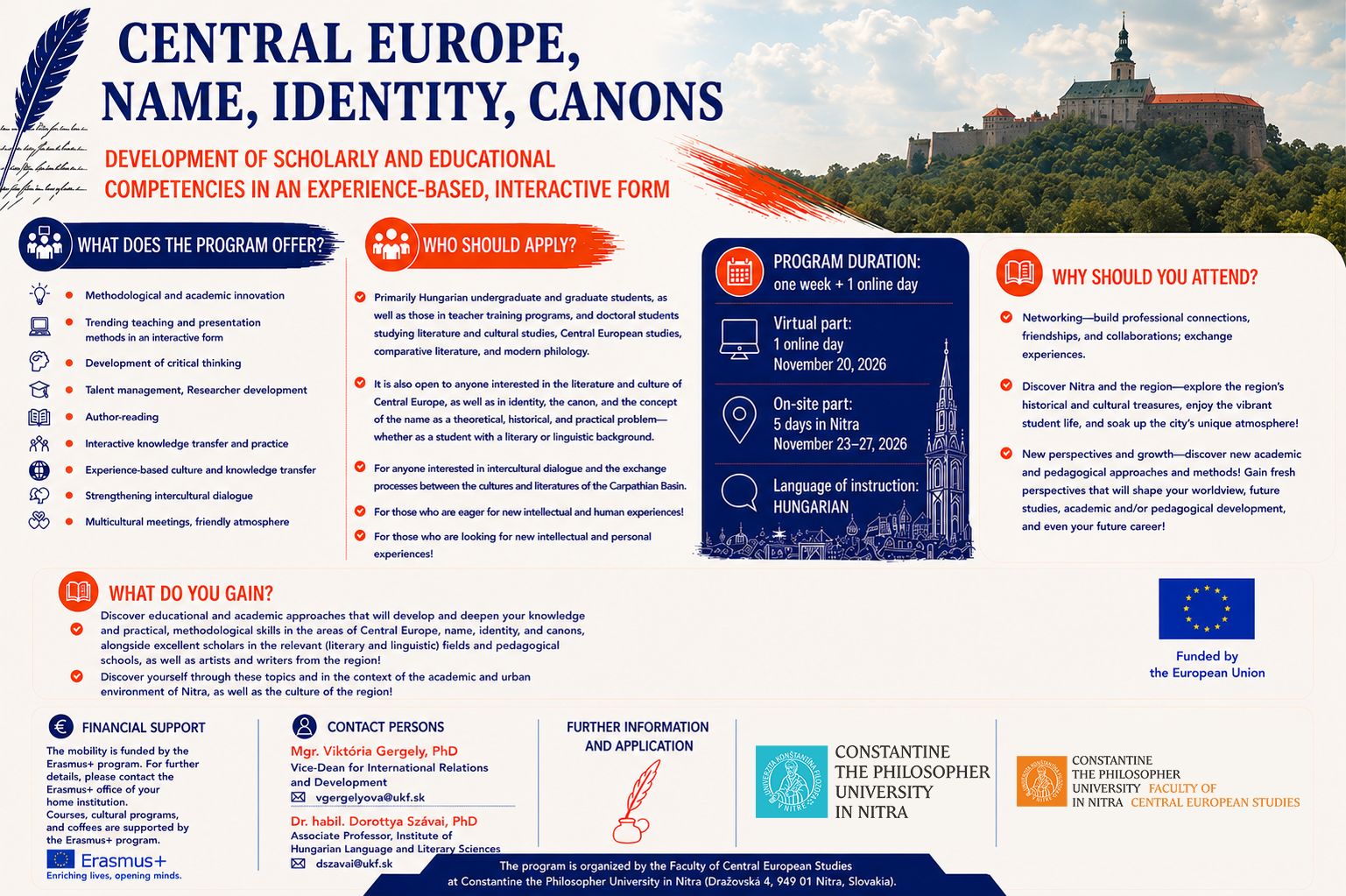
In 2026, Constantine The Philosopher University of Nitra will organise a Blended Intensive Programme (BIP) entitled „Central Europe, name, identity, canons. Development of scholarly and educational Competencies in an experience-based, interactive Form”. The event, coordinated by the Faculty of Central European Studies, will take place in Nitra between 23 and 27 November 2026.
The programme is primarily aimed at Hungarian undergraduated and graduated BA and MA students, as well as those on teacher training programmes, and at PhD students studying literature and cultural studies, Central European studies, comparative literature and modern philology.
Aim of the program:
The program offers new perspectives and development: familiarising oneself with new academic and pedagogical schools of thought and methods; acquiring fresh perspectives; deepening critical thinking; and fostering the next generation of teachers and academics. Acquiring educational and academic approaches that develop and deepen knowledge and practical, methodological skills in the fields of Central Europe, name, identity and canons, with the assistance of excellent scholars in the relevant (literary and linguistic) disciplines and pedagogical schools, as well as the region’s writers and artists. All this takes the form of interactive knowledge transfer and exercises, as well as experience-based cultural and knowledge dissemination, with the aim of strengthening intercultural dialogue as widely as possible.
The long-term objectives of the initiative include expanding cooperation between partner institutions within a larger network, in the fields of education, science and the training of the next generation of scientists.
Structure of the programme
The BIP consists of two main components: a virtual part and an On-site part. The online session will take place on 20 November 2026; its aim is to provide a comprehensive overview of the programme’s structure, to introduce the partner institutions and participants, and, in the form of an academic workshop, to provide a theoretical framework for the fundamental issues surrounding Central and Eastern European identity, name and cultural canons, as well as their comparative analysis. This preparatory phase will lay the foundations for the effectiveness of subsequent face-to-face activities and practical sessions.
The physical mobility phase – which will take place between 23 and 27 November 2026 – consists of academic and educational workshops, as well as experiential activities. The aim of these is to acquire theoretical and practical knowledge and to develop skills that can be utilised most effectively by future teachers and young researchers can utilise most effectively in the aforementioned fields, as well as to foster their cultural identity and awareness, and to develop and deepen their methodological knowledge, academic toolkit and argumentative skills.
Participants will discuss what they have learnt during the week, as well as the methods mentioned above.
As part of the practical training, students will visit Nitra and other cultural centres in the region. The programme concludes with creative group work and a presentation of the outcomes developed by the students.
The experience, knowledge and skills gained in this way can be utilised in the future as well.
International cooperation and innovation in education
The programme strengthens international cooperation, facilitating the sharing of innovative teaching methods, professional networking and the exchange of experiences amongst participating institutions. The initiative is being implemented in partnership with the Faculties of Humanities at Károli Gáspár Reformed University in Budapest, the Faculty of Humanities and Arts Eszterházy Károly Catholic University of Eger and the Faculty of Letters and Arts of Partium Christian University of Nagyvárad/Oradea, as well as the Department of Hungarian of L’Orientale University of Naples.
The project framework promotes knowledge-sharing, collaborative learning and a deeper understanding of intercultural relations. The programme helps participants to further expand their academic and pedagogical knowledge regarding Central European identity, literary naming conventions and place names, as well as the constantly evolving cultural, literary and linguistic canons in the region, and to gain practical intercultural experience in these areas.
(Clicking on the image opens it in full size)
